
 Memory Interconnect
 PCIe® Interconnect
 CXL® Interconnect





 Contact Us

 2026-10-19
Abstract — As LLMs scale from billions to trillions of parameters and context lengths approach the million-token level, traditional GPU and HBM centric scaling is reaching its limits, accelerating the transition toward sparse activation and hardware tiered storage architectures. We analyze why Multiplexed Rank Dual Inline Memory Module (MRDIMM) and Compute Express Link® Memory eXpander Controller (CXL® MXC) are inevitable choices to solve real-time bottlenecks and scalability issues in next-generation high-performance AI inference systems.
Index Terms — AI Inference, CXL MXC, Large Language Models, MRDIMM, Sparse Activation.
The Memory Wall in AI Inference: Exploding Model Scale and Physical Memory Limits
Current Large Language Models (LLMs) are experiencing a drastic evolution from billions to trillions of parameters. As context lengths approach the million-level mark, the traditional scaling model centered on increasing GPU counts and HBM (High Bandwidth Memory) has reached its physical and economic limits.
A critical technical reality is that in a 1M context environment, the KV Cache required for a single request reaches up to 150GB. This makes local HBM not only "expensive", but also structurally unscalable in high-concurrency production environments. Based on the evolutionary trend from GPT-3 (175B) in 2020 to the predictions for 2026, we are at a critical juncture:
Linear Synchronization of Parameters and Memory: From Llama 3 (8B/14GB) to Future LLM (1T/2000GB), memory demand skyrockets linearly with parameter scale [1].
KV Cache Explosion in Long Contexts: From 1.3GB at an 8K length to 150GB at a 1M length, the HBM supply-demand gap continues to widen [2].
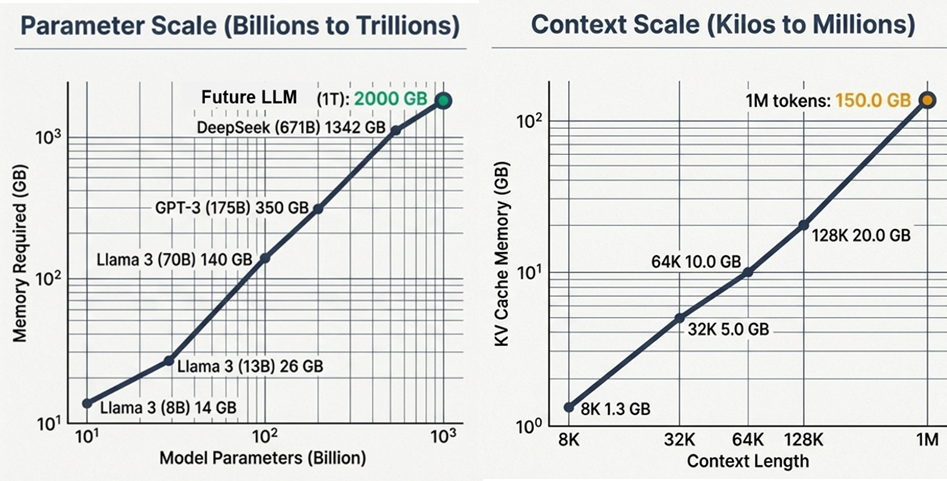
Fig1. Parameter Scale[1] Fig2. Context Scale[2]
ALGORITHMIC EVOLUTION: FROM MOE TO DEEPSEEK ENGRAM
To resolve the massive computational load brought by Dense models, LLM architectures are shifting from "full activation" to "Sparse Activation". This trend creates offloading opportunities for hardware tiered storage.
The Decoupling Logic of Memory Status
Standard Transformer: Utilizes dense computation, where all parameters are active during the generation of each token, and memory is entirely locked in the expensive GPU HBM.
MoE (Mixture of Experts): Activates only the top-k experts through routing; although the computation volume decreases, it still imposes extremely high demands on GPU HBM utilization.
DeepSeek Engram: Introduces Conditional Memory, opening an entirely new dimension for sparsification. The core logic involves the mathematical decoupling of computation and querying. It extracts static knowledge into an O(1) N-gram lookup table, allowing Dynamic Reasoning [4].
O(1) Table Lookup and Host RAM Offloading: The paper “Conditional Memory via Scalable Lookup: A New Axis of Sparsity for Large Language Models”, Jointly published by DeepSeek and Peking University, explicitly states that by completely offloading the massive N-gram lookup data table (up to the 100B parameter scale) to the CPU Host RAM and utilizing Deterministic Addressing for prefetching, extremely low-latency O(1) knowledge retrieval can be achieved without occupying valuable GPU HBM. Empirical results in the paper demonstrate that this approach of offloading memory to the Host DRAM incurs less than a 3% degradation in overall throughput performance.
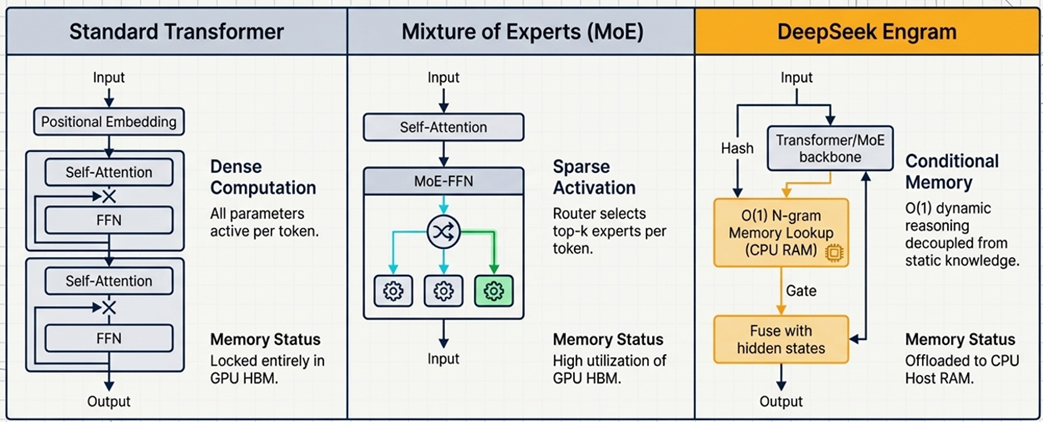
Fig. 3. Algorithmic Evolution: From Mixture of Experts (MoE) to DeepSeek Engram [4]
MRDIMM: THE SECOND LEAP IN HOST MEMORY BANDWIDTH
When Engram offloads the knowledge lookup table to the host side, traditional RDIMMs often struggle with bandwidth and latency performance. MRDIMM (Multiplexed Rank Dual Inline Memory Module) is the core component to address this demand.
Hardware Architecture Breakdown: Pseudo-Channels and Multiplexing
MRDIMM achieves a second leap in bandwidth through a multiplexing architecture combined with improved memory controllers:
Multiplexed Topology: Uses MRCD (Multiplexed Rank Registering Clock Driver) and MDB (Multiplexed Rank Data Buffer) to access two physical ranks simultaneously.
80-bit Sub-channel Technology: Multiplexes two pseudo-channels into a single double data rate signal, achieving 2x Data Rate.
Parallel Instruction Streams: The MRCD sends instructions to pseudo-channels (PS0 and PS1) simultaneously for extreme access parallelism.
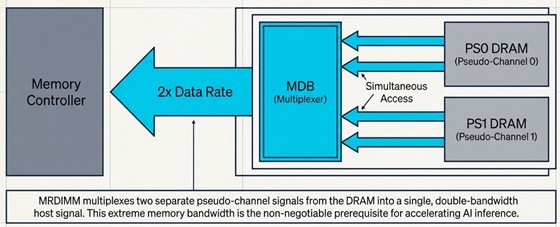
Fig4. MRDIMM 2Rx4 Architecture [3]
Quantitative Performance Analysis
The core of MRDIMM's ability to break the traditional DDR5 speed bottleneck lies in its innovative multiplexed buffer architecture.
Chipset Configuration: According to JEDEC specifications, a standard MRDIMM requires 1 MRCD and 10 MDBs.
Data Multiplexing: The MDB chip allows two different Ranks to be accessed in parallel within the same clock cycle. By multiplexing the low-speed data streams from multiple DRAM chips through the internal circuitry of the MDB chip, the MRDIMM can deliver a transfer rate to the Host side that is twice that of the native backend DRAM.
Empirical comparisons in AI inference scenarios (MRDIMM 8800 vs. DDR5) reveal: [5]
Throughput Advantage: Under a high load with a concurrency of 8, MRDIMM 8800 reached 39.20 tps, improving by approximately 18.8% compared to DDR5 6400 (33.00 tps). When compared to the baseline DDR5 4800, the improvement soars to 40.5%.
Latency Control: At high concurrency, MRDIMM stably maintains inter-token latency below the 250ms SLA (actual measurement: 206ms). In contrast, DDR5 6400 approaches the critical threshold (243ms), and DDR5 4800 exceeds it (268ms), proving that MRDIMM more reliably ensures the fluency of inference services.
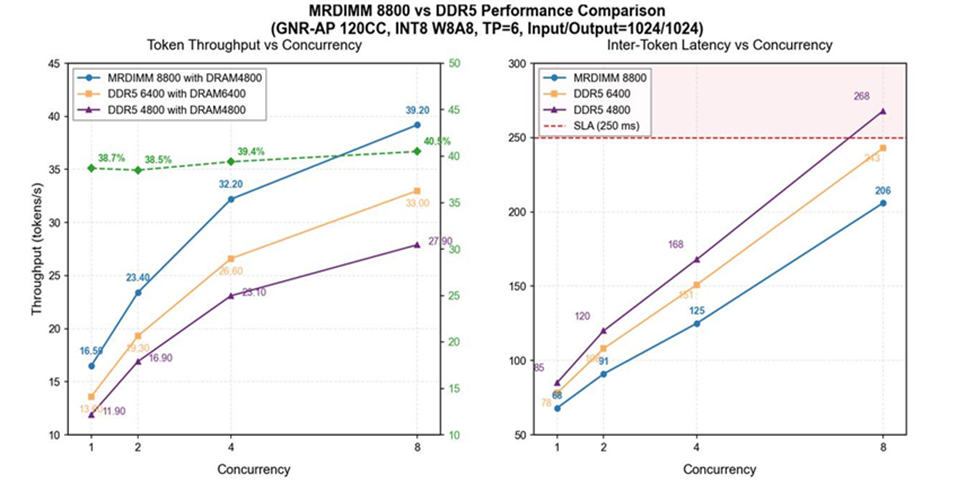
Fig5. Token Throughput and Latency Efficiency [5]
CXL MXC: BUILDING AN FLEXIBLE AND SCALABLE MEMORY RESOURCE POOL
Bandwidth solves the "speed" issue, but facing the giant Engram lookup tables, single-node slot limitations restrict the "capacity" ceiling. CXL MXC (Memory eXpander Controller) is the key component to enable the "memory expansion" needed to break this limitation [3].
Technical Specification Evolution and Foundation
The CXL protocol is achieving leapfrog advancements by following the evolutionary path of PCIe®:
CXL 1.0/1.1: Based on PCIe 5.0, providing coherent memory access at 32 GT/s.
CXL 3.0: Based on PCIe 6.0, it delivers a data transfer rate of 64 GT/s. Key breakthroughs include support for memory sharing and multi-level fabric architectures, as well as the addition of multi-head device capabilities, enabling switchless direct connections and large-scale resource disaggregation.
CXL 4.0: Expected to be based on PCIe 7.0, with bandwidth soaring to 128 GT/s.
CXL NUMA: MXC supports the expansion of CPU memory resources, maximizing the memory resources allocated to each CPU core.
The Mathematical Prerequisite for Eliminating AI Hallucinations
Expanding memory capacity is a mathematical necessity for precision. Empirical data show that:
Hash Collision Rate: Expanding capacity decreases the collision rate of Engram lookup tables from 3.01% to 0.13%.
Accuracy Improvement: Lowering collision rates is the mathematical prerequisite for reducing model mismatch errors.
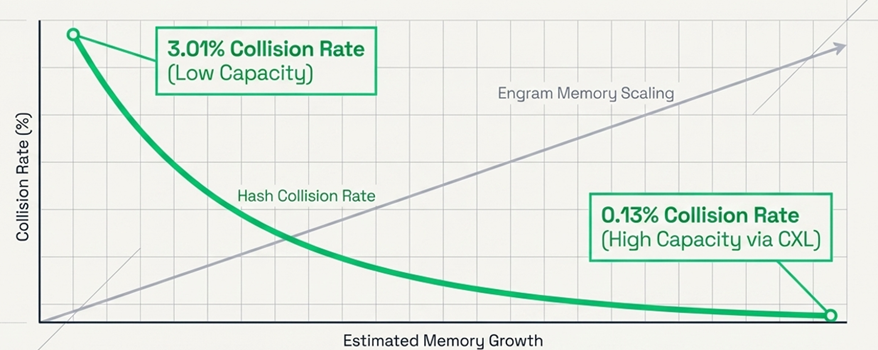
Fig6.Hash Collision vs. Memory Growth [6]
Engram Module and Hash Collision
In their paper, DeepSeek proposed the "Engram" conditional memory module, which operates by utilizing O(1) multi-head hash addressing to look up the static knowledge required by the model. As long as a hash table is used, the system will inevitably face the mathematical and physical constraint of "hash collisions." To reduce the collision rate and ensure the accuracy of knowledge retrieval (thereby eliminating AI hallucinations), the most direct mathematical prerequisite is to massively expand the memory capacity of the hash table (Memory Scaling). This is precisely the perfect inverse relationship presented in the chart between the X-axis (estimated memory growth) and the Y-axis (decrease in collision rate). [6]
Breaking GPU Limits and CXL Expansion (High Capacity via CXL)
To solve the issue of strict capacity limits in GPU High Bandwidth Memory (HBM), the architectural design of Engram allows massive embedding tables of up to hundreds of billions of parameters (100B+) to be offloaded to the Host Memory. Under current server hardware architectures, when discussing such large-scale pooling and expansion of host memory capacity, CXL (Compute Express Link) technology is precisely the most core and widely discussed implementation solution. [6][7]
MONTAGE TECHNOLOGY'S MRDIMM AND CXL MXC PRODUCT MATRIX AND LEADING POSITION
As a global leader in the field of memory interface chips, Montage Technology has completed deep deployments at the critical nodes of MRDIMM and CXL MXC.
MRDIMM Product Generations and Performance Specifications
Montage Technology offers MRCD/MDB memory interface chipsets for MRDIMMs:
Generation 1 (Gen 1): Supports data transfer rates up to 8800 MT/s.
Generation 2 (Gen 2): Supports rates up to 12,800 MT/s—a significant 45% increase over Gen 1—and is poised to enter the stage of large-scale application.
Montage Technology is one of only two suppliers worldwide to mass-produce both Gen 1 and Gen 2 MRCD/MDB chipsets.
Comparison Table of Montage Technology's Three Generations of CXL Memory Controllers (MXC)
Comparison Dimension | M88MX5891/5851 | M88MX6852 (Latest) |
Host Interface PHY | PCIe 5.0 (32 GT/s) | PCIe 6.2 (64 GT/s) |
CXL Protocol | CXL 1.1 / 2.0 | CXL 2.0 / 3.2 (Supporting DCD, MLD) |
Max Memory Rate | 1 channel DDR4/5 | Dual channel DDR5 |
Memory Channel Configuration | Dual channel | Dual independent DDR5 channels (2x 80-bit I/O) |
Microprocessor Architecture | Single RISC-V | Dual RISC-V (APU+SPU) |
Security Features | Secure boot/Device attestation/IDE | SPDM 1.4 + TSP + PQC (Post Quantum Crypto) |
Package/Form Factor | 19x19mm E1.S, E3.S, AIC | 25x25mm E3.S, AIC |
Key Technical Specifications and Performance
Ultra-High Bandwidth and Speed: Based on the PCIe 6.2 physical layer interface, the data transfer rate reaches up to 64 GT/s (x8 lanes). It supports flexible configurations of multiple rates and bit widths (e.g., can be split into two x4 ports).
Memory Interface Upgrade: Integrates a dual-channel DDR5 memory controller, with operating rates reaching up to 8000 MT/s, tremendously improving the data exchange efficiency between the host CPU and backend memory modules.
Protocol Support: Fully supports CXL.mem and CXL.io protocols.
To translate architectural ideals into commercial reality, the design precision of memory controllers is crucial. Targeting different application scenarios, Montage Technology has launched an MXC product matrix spanning three generations, balancing cost and performance:
Asset Activation and TCO Optimization (M88MX5891/5851): Supports hybrid memory interfaces, not only compatible with DDR5 but also supports the reuse of DDR4-3200. This allows data centers to quickly build CXL expansion architectures without scrapping existing DDR4 assets, increasing return on investment.
Next-Generation Higher Bandwidth (M88MX6852): Leads the industry by introducing the PCIe 6.2 (64 GT/s) interface and a dual-channel DDR5 controller, pushing the memory rate to an astounding DDR5-8000, matching the high-performance AI computing demands under the CXL 3.2 protocol.
SYSTEM BENEFITS ANALYSIS: THROUGHPUT, COST, AND ROI
The integration of Engram algorithms, MRDIMM bandwidth, and CXL flexible expansion demonstrates an outstanding "economy of scale".
Performance Improvement: CXL memory pools can provide over 45% throughput growth for inference systems.
TCO Savings (For a 400B Engram model across 16 nodes):
○ Traditional Local Expansion: Each node must be independently configured with high-capacity memory, resulting in a high total cost of $192,000.[4]
○ CXL Pooling Solution and CXL NUMA: A model in which each node is configured with low-to-medium capacity memory and expanded using CXL. The total pooled cost for memory sharing is $25,960, while the cost of CXL pooling solution is even lower than that of the traditional local expansion.
○ ROI Assessment: In comparison, this saves at least over $166,040 in infrastructure costs. This demonstrates the concept of "Exponential Value at Scale": as the number of nodes increases, the marginal cost of CXL Memory decreases, shifting the infrastructure cost curve from steep linear growth to flat, economic expansion.[4]
CONCLUSION: SETTING THE STANDARD FOR NEXT-GENERATION AI INFERENCE
Facing the "memory wall" of the LLM era, single-point breakthroughs are no longer enough. The deep synergy of "Algorithm Sparsification + Memory Tiering" is the inevitable developmental path. MRDIMM carries high-bandwidth dynamic queries, while CXL MXC acts as flexible memory capacity. Montage Technology provides the foundational, hardcore support for this future architecture through its world-leading MRCD/MDB and MXC chip solutions. Together, they form the standard configuration for next-generation high-performance AI inference systems.
REFERENCES
[1]
DeepSeek-AI. (2024/2025). "DeepSeek-V3 / DeepSeek-R1 Technical Report."
Meta AI. (2024). "The Llama 3 Herd of Models." arXiv preprint arXiv:2407.21783.
Aminabadi, R. Y., et al. (Microsoft DeepSpeed). (2022). "DeepSpeed Inference: Enabling Efficient Inference of Transformer Models at Unprecedented Scale."
[2]
Kwon, W., et al. (vLLM Team). (2023). "Efficient Memory Management for Large Language Model Serving with PagedAttention." Proceedings of the 29th Symposium on Operating Systems Principles (SOSP).
Hooper, C., et al. (UC Berkeley). (2024). "KVQuant: Towards 10 Million Context Length LLM Inference with KV Cache Quantization." Conference on Neural Information Processing Systems (NeurIPS 2024).
[3]
Compute Express Link (CXL) Consortium. (2023/2024). "Compute Express Link (CXL) Specification 3.1 / 4.0 Architecture."
JEDEC Solid State Technology Association. "Multiplexed Rank Dual Inline Memory Module (MRDIMM) Core Specification."
[4]
DeepSeek-AI, "Conditional Memory via Scalable Lookup: A New Axis of Sparsity for Large Language Models," arXiv preprint arXiv:2601.07372, 2026. Available: https://arxiv.org/abs/2601.07372
[5]
Montage Technology, "Quantitative Performance Analysis of MRDIMM 8800 vs. DDR5 6400 in AI Inference Scenarios," Montage Technology AI Server Lab, Internal Test Report, Apr. 2026.
[6]
DeepSeek-AI, "Conditional Memory via Scalable Lookup: A New Axis of Sparsity for Large Language Models," GitHub repository, Jan. 2026. [Online].
[7]
Pooling Engram Conditional Memory in Large Language Models using CXL," arXiv preprint arXiv:2603.10087, Mar. 2026.
